Anyone who would like to qualify as a Court Interpreter must first submit an Application to Become a Court Interpreter using the link below.
How to Become a Court Interpreter
ANNOUNCEMENTSUpcoming Changes Starting in 2027, some minor changes will be made to the order of requirements for Approval and Certification. These changes will not affect any credentials you have already obtained.
Ethics CEU Opportunity On November 20, the Language Access Program will be offering a 2-hour training that will count toward required ethics CEUs. Click here to find out more and to register. |
|---|
Court Interpreter Credentials
From their highest to lowest qualifications, Utah Court Interpreters are credentialed as:
Certified: Certified Court Interpreters are the most highly qualified interpreters in Utah. To become Certified, you must complete every single requirement shown in the table below. Most notably, you must pass the Oral Exam.
Approved: You may begin working as an interpreter once you become Approved. To become an Approved Court Interpreter, you must complete all of the Basic Requirements shown in the table below, as well achieve a rating of Superior on the Oral Proficiency Interview.
Registered: For some languages, there is no Oral Exam available. A list of languages for which the Oral Exam is offered can be found here. If the non-English language that you interpret is not on this list, becoming Registered is the highest credential available to you. You must complete the Basic Requirements outlined in the checklist below in order to become Registered.
Conditionally Approved: Sometimes, Certified, Approved, or Registered interpreters are not available, in which case a Court may use a Conditionally Approved Interpreter. Conditionally Approved interpreters may only be appointed if an appointing authority finds it necessary, in accordance with CJA Rule 3-306.04(1)(C). In order to become Conditionally Approved, candidates must complete the application and the background check (two of the Basic Requirements listed below), as well as complete this application form specific to conditional approval: Application for Conditional Approval.
Summary of Requirements
Following is a summary of the requirements for becoming a credentialed interpreter if you live in Utah.
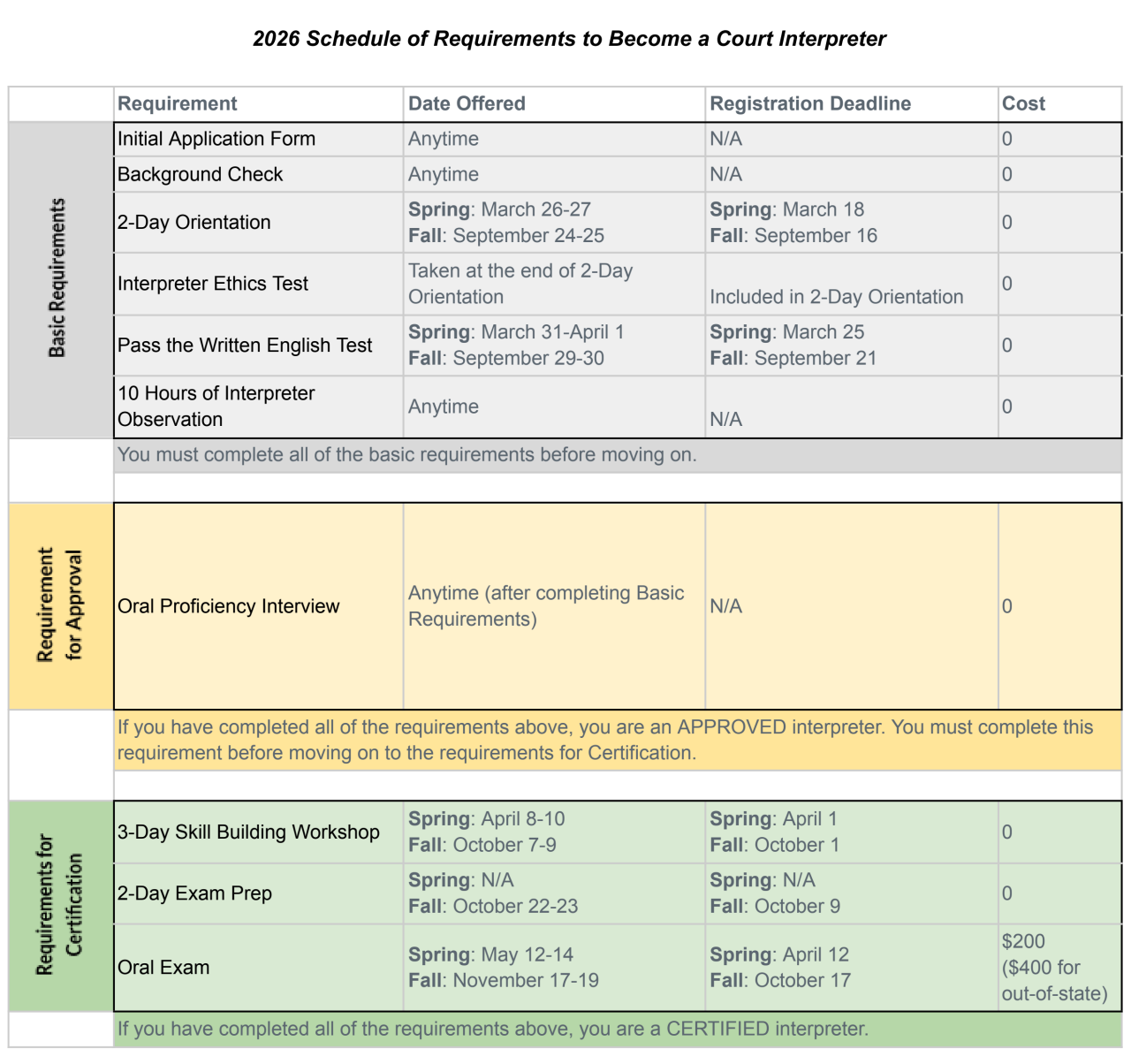
Currently, all fees have been waived with the exception of the Oral Exam.
If you want to become an ASL Court Interpreter, these requirements may apply to you. Please visit the American Sign Language page to find information on the requirements for becoming an ASL Court Interpreter.
Interpreter Rates
Per-Hour Rates (The rates above only apply to local interpreters)
- Certified - $57
- Approved - $41
- Registered - $41
- Conditionally Approved - $23
Utah interpreters are paid the above rates with a two-hour minimum. Interpreters may also receive a mileage compensation depending on the distance traveled to an assignment. For a more thorough description of compensation, including details about the two-hour minimum and travel compensation, please see the Court Interpreter Section (Section 9) of the Court Accounting Manual.
Basic Requirements
The Administrative Office of the Courts needs to conduct a background check on every interpreter candidate. The background check is based on the identifying information provided. If you do not pass the background check, you may appeal the decision within 30 days to the Language Access Committee. All Court Interpreters must pass a background check every two years (see UJCA Rule 3-306.03 (7)).
When filling out the form, please do the following:
Select “Contract Interpreter” for both the Position Type and the Job Title.
Enter “SLC/3rd District/OFA” for the Court Location.
Enter “Ramon Rudecindo” for the name of the Court employee who requested you fill out the form.
Ramon, the Language Access Program Manager, will reach out if your background check reveals any concerns. If you do not hear from him, you can assume that your background check was successfully cleared.
Interpreter candidates must complete the 2-Day Orientation as part of the Basic Requirements described above. This language-neutral training is offered twice annually, and the certificate of completion is valid for two years from the date the class was attended.
The 2-Day Orientation will provide you with an overview of the court interpreting profession. Topics of the Orientation will include the basics of the justice system, the role of court interpreters, proper conduct of court interpreters, and the skills required to be a court interpreter.
The dates and registration deadlines for the 2-Day Orientation this year are as follows:
SPRING: March 26-27, 2026 Registration Deadline: March 18, 2026
FALL: September 24-25, 2026 Registration Deadline: September 16, 2026
The 2-Day Orientation will be held at 450 S State St, Salt Lake City, UT 84114.
If you are a participant in the Fall 2026 cohort of USU's court interpreter training program, these dates do not apply to you. Please refer to the program schedule for the correct dates, as provided by the Program Manager.
2-Day Orientation Registration Form (Closed)
Interpreter candidates must take and pass an examination on Utah’s Code of Professional Responsibility for Court Interpreters, which serves as a code of ethics for court interpreters in the state. It consists of approximately 20 multiple-choice questions about what interpreters should do when confronted with a given ethical dilemma.
Interpreter candidates will take this test at the end of the 2 Day Orientation.
If you need to take the Ethics Test separately from the 2-Day Orientation (as an out-of-state interpreter, for example), please contact languageaccessprogram@utcourts.gov to schedule it.
Interpreter candidates must pass a multiple-choice exam with a minimum score of 80%. The exam will test your knowledge of vocabulary and idiomatic usage of English, courtroom language, and interpreter ethics, among other things. For more information about the test, including sample questions and practice suggestions, read the official NCSC Written Exam Overview.
The dates and registration deadlines for the Written Exam this year are as follows:
SPRING: March 31-April 1, 2026 Registration Deadline: March 25, 2026
FALL: September 29-30, 2026 Registration Deadline: September 21, 2026
The Written Exam will be administered at 450 S State St, Salt Lake City, UT 84114.
The exam may also be offered in the Fifth District Courthouse in St. George upon request. Please contact languageaccessprogram@utcourts.gov for more information.
If you are a participant in the Fall 2026 cohort of USU's court interpreter training program, these dates do not apply to you. Please refer to the program schedule for the correct dates, as provided by the Program Manager.
English Written Exam Registration Form (Closed)
Interpreter candidates must observe Certified Court Interpreters doing their job for a total of 10 observation hours. Most certified court interpreters interpret in Spanish, but the candidate, regardless of language, is there to observe the participation of the interpreter in the court process, not to learn language or interpretation skills. If you are observing proceedings via Webex, you must keep your mic muted and your video turned off unless instructed otherwise.
To begin your 10 hours of observation, download the Observation Hours Log Sheet below, and contact the interpreter coordinator in your district for a schedule of upcoming interpreter assignments you may observe. To find your corresponding interpreter coordinator’s contact information, see the List of Interpreter Coordinators.
Observation Hours Log Sheet
Requirement for Approval
After completing all of the above Basic Requirements, interpreter candidates can schedule an Oral Proficiency Interview (OPI) by contacting the Program Manager at languageaccessprogram@utcourts.gov. To become Approved, you must score a Superior rating on the OPI in your non-English language.
A Superior rating requires more than superb grammar, vocabulary, and interlocution; scoring a Superior rating means you can fluently participate in conversations on a variety of subjects, employ extended discourse and structured arguments, and ultimately deal with topics abstractly, not just concretely.
See the following links for more information about what the OPI is and how it is scored.
The Oral Proficiency Interview is conducted live over the phone with a Certified ACTFL Tester. Please contact the Program Manager at languageaccessprogram@utcourts.gov to schedule your interview after you have completed all of the Basic Requirements. Be ready to provide two dates and times during which you have a three-hour block of availability. The Program Manager will confirm the test date, and provide you with your test scores once they are available.
If you are a participant in the Fall 2026 cohort of USU's court interpreter training program, please refer to the program schedule for the date of your Oral Proficiency Interview, as provided by the Program Manager.
Requirements for Certification
Enrollment in the 3-Day Skill Building Workshop is limited to interpreter candidates who have already become Approved Court Interpreters by successfully completing all of the requirements above. The 3-Day Skill Building Workshop is the next requirement to advance from Approval to Certification.
This workshop will provide in-depth instruction on all modes of interpretation and practice techniques. The primary focus of this workshop is to help you prepare to work professionally as an interpreter.
The dates and registration deadlines for the 3-Day Skill Building Workshop this year are as follows:
SPRING: April 8-10, 2026 Registration Deadline: April 1, 2026
FALL: October 7-9, 2026 Registration Deadline: October 1, 2026
The 3-Day Skill Building Workshop will be held at 450 S State St, Salt Lake City, UT 84114.
If you are a participant in the Fall 2026 cohort of USU's court interpreter training program, these dates do not apply to you. Please refer to the program schedule for the correct dates, as provided by the Program Manager.
Workshop Registration Form (Closed)
The 2-Day Exam Prep Workshop is another requirement of Certification that can be started after becoming Approved, and takes place shortly after the 3-Day Skill Building Workshop. The 2-Day Exam Prep Workshop is held two times per year at the Matheson Courthouse in downtown Salt Lake City.
This workshop will primarily focus on preparation for the Oral Examination; participants can expect to learn more about the way the test is structured and graded, and most importantly, take mock exams to determine where they can improve before taking the official exam.
The dates and registration deadlines for the 2-Day Exam Prep Workshop this year are as follows:
SPRING: N/A Registration Deadline: N/A
FALL: October 22-23, 2026 Registration Deadline: October 9, 2026
The 2-Day Exam Prep Workshop will be held at 450 S State St, Salt Lake City, UT 84114.
If you are a participant in the Fall 2026 cohort of USU's court interpreter training program, these dates do not apply to you. Please refer to the program schedule for the correct dates, as provided by the Program Manager.
Workshop Registration Form (Closed)
After completing all of the above steps, a candidate must pass the National Center for State Courts’ Oral Exam in order to become a Certified Court Interpreter. This is the most difficult requirement of becoming Certified, and requires intensive work beyond attending the required workshops. The exam consists of three main parts corresponding to the principal modes of interpretation—sight translation, consecutive interpretation, and simultaneous interpretation. To become certified, you must pass each part with a minimum score of 70%, passing all three parts within two years of each other.
For more information about how the Oral Exam is designed and how to prepare for it, see the following official documents.
Common Exam Performance Deficiencies
List of languages in which Oral Exam is available
The dates and registration deadlines for the Oral Examination this year are as follows:
SPRING: May 12-14, 2026 Registration Deadline: April 12, 2026
FALL: November 17-19, 2026 Registration Deadline: October 17, 2026
The Oral Exam will be administered at 450 S State St, Salt Lake City, UT 84114.
The fee (subject to change without notice) is $200 for Utah residents and $400 for non-residents and is non-refundable. Pre-registration is required, and payment is due upon registration. If your registration and payment have not been received by the deadline you will not be able to take the exam.
Oral Proficiency Exam Registration Form (Closed)
Frequently Asked Questions
Only interpreters that live in Utah may be listed on Utah’s roster. However, interpreters with credentials from another state can still gain reciprocity with Utah. If you live in another state and have fulfilled Utah’s reciprocity requirements (listed below), then you can be recognized as a credentialed interpreter in Utah, and thus take virtual assignments.
These are requirements for obtaining and maintaining reciprocity:
- Complete the Initial Application Form
- Pass the Background Check
- Pass the Interpreter Ethics Test
- Score a Superior rating on the Oral Proficiency Interview administered by Language Testing International
- Score 70% on all three parts of the NCSC Oral Examination
- Comply with Utah’s Continuing Education Requirements for Interpreters
Court interpreters outside of Utah seeking reciprocity will need to pay the third–party providers for these services themselves, if applicable. If you have already completed one or more of these requirements, proof of completion may satisfy that requirement. Please contact languageaccessprogram@utcourts.gov if you have additional questions.
Some of the requirements in this page may apply to you. Please visit the American Sign Language page to find information on the requirements and application for becoming an ASL Court Interpreter.
Certified Court Interpreters must complete at least 16 hours of continuing education every two years, beginning the January after they have become Certified. For more information, see our webpage on Continuing Education Requirements.